Chasing Light and Stillness: Where Hiroshima’s Wild Beauty Comes Alive Through the Lens
You know what? I never expected Hiroshima to be this breathtakingly raw and real. Beyond its profound history lies a world of quiet forests, misty mountains, and coastal wonders that feel untouched. As a photographer, I was blown away by how nature here tells its own story—one of resilience, balance, and pure visual poetry. This is not just travel; it’s a chance to capture moments where light dances on water and silence speaks louder than words. From the tidal rhythms of Miyajima to the alpine hush of Shirakawa Valley, Hiroshima reveals a landscape shaped by time, weather, and quiet renewal. For those who seek not only to see but to feel a place through their lens, this region offers some of Japan’s most emotionally resonant and visually rich experiences.
Why Hiroshima? The Hidden Natural Heart Behind the City’s Name
When most travelers hear "Hiroshima," their minds turn immediately to history—specifically, the tragic events of August 6, 1945, and the powerful message of peace that has risen from them. The Peace Memorial Park, the Atomic Bomb Dome, and the moving testimonies of survivors form an essential part of global awareness. Yet, what often goes unnoticed is how deeply nature has woven itself back into the fabric of this city and its surrounding prefecture. Hiroshima is not only a symbol of human endurance but also a living example of ecological recovery and harmony. Over decades, forests have regrown, rivers have cleared, and wildlife has returned, creating a natural landscape that stands as quietly powerful as the city’s monuments.
The geography of Hiroshima Prefecture plays a crucial role in this renewal. Nestled along the Seto Inland Sea, it benefits from a mild maritime climate that supports lush vegetation and diverse ecosystems. Rolling hills, terraced farmland, and river valleys define much of the inland terrain, while the coastline offers rocky shores, tidal flats, and forested islands. This blend of land and water creates ideal conditions for outdoor photography, where every season paints the scenery in new hues. Mist clings to mountain slopes in spring, autumn sets the hills ablaze with color, and winter light casts long, dramatic shadows across frozen fields.
Equally important is the cultural philosophy that supports this balance: the concept of *satoyama*. This traditional Japanese term refers to the border zone between mountain forests and agricultural villages, where human activity and natural processes coexist in a sustainable rhythm. In Hiroshima’s rural areas, you’ll find rice paddies bordered by bamboo groves, orchards tucked into hillside clearings, and irrigation channels fed by forest springs. These landscapes are not wild in the untouched sense, but cultivated with care, allowing both people and nature to thrive. For photographers, *satoyama* offers a unique aesthetic—orderly yet organic, serene yet alive with subtle movement. It’s a visual language of balance, one that rewards patient observation and thoughtful framing.
What makes Hiroshima especially compelling for nature photography is its accessibility. Unlike remote wilderness areas that require days of trekking, many of these scenic spots are within an hour’s train or ferry ride from the city center. This means travelers can experience profound natural beauty without sacrificing comfort or convenience. Whether you’re an early riser chasing dawn light on a quiet shore or a hiker seeking solitude in the misty highlands, Hiroshima offers a rare combination of emotional depth and visual richness. It invites you not just to photograph, but to reflect.
Miyajima: More Than Just the Floating Torii—Photographing Nature’s Rhythms
Miyajima, officially known as Itsukushima, is one of Japan’s most photographed islands, famous for its "floating" torii gate that appears to rise from the sea at high tide. While the shrine complex draws millions each year, the island’s true photographic treasures lie beyond the postcard views. Surrounded by the calm waters of the Seto Inland Sea and blanketed in dense evergreen forest, Miyajima is a living ecosystem shaped by daily tides, seasonal migrations, and centuries of quiet coexistence between people and nature. For photographers willing to look deeper, it offers endless opportunities to capture movement, mood, and quiet moments of connection.
The island’s tidal cycle is perhaps its most dynamic feature. Twice a day, the water level shifts dramatically, transforming the shoreline from a submerged expanse into a vast, textured flat of mud and rock. At low tide, the exposed seabed becomes a natural canvas—rippled with patterns, dotted with shells, and crossed by the delicate tracks of birds and crabs. This is the perfect time for long-exposure photography, using shutter speeds of several seconds to blur the motion of returning waves into soft, milky veils. A polarizing filter helps reduce glare and deepen the contrast between wet and dry surfaces, enhancing the sculptural quality of the landscape.
Morning light on the tidal flats can be especially magical. As the sun rises behind the hills, it casts a golden glow across the water, illuminating the torii gate from the side rather than head-on. This angle creates depth and dimension, turning a familiar icon into something fresh and atmospheric. Fog often lingers in the early hours, wrapping the shrine and forest in a soft haze that enhances the sense of mystery. For those seeking solitude, arriving before 7 a.m. ensures fewer crowds and more opportunities for unobstructed compositions.
The island’s famous deer—considered sacred in Shinto tradition—add another layer of life to the scenery. Unlike urban deer populations that may appear stressed or aggressive, Miyajima’s animals move with calm grace, often pausing in sunlit clearings or stepping silently through the trees. Capturing them requires patience and a respectful distance; zoom lenses of 200mm or more allow for intimate portraits without intrusion. Early morning and late afternoon are the best times, when the deer are most active and the light is warmest. A slightly slower shutter speed—around 1/250th of a second—can preserve motion in their ears or tails, adding a sense of life to still images.
For dramatic skies, aim for overcast or stormy days. When clouds press low over the mountains and the sea darkens, the torii gate takes on a solemn, almost spiritual presence. Use a wide-angle lens to include both the gate and its reflection in the shallow water, and adjust your exposure to retain detail in the wooden structure. These conditions are rare but unforgettable, turning a well-known subject into a powerful study of contrast and mood. The key is to move beyond the postcard and see Miyajima as a living landscape—one that breathes with the tides, shelters wildlife, and changes with every shift in light.
Mount Misen: A Canopy of Mist and Light
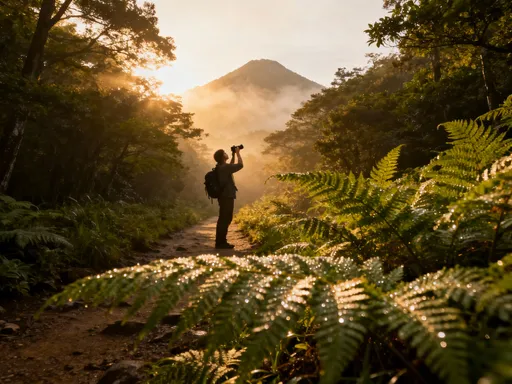
Rising 535 meters above sea level at the heart of Miyajima, Mount Misen is more than a hiking destination—it’s a journey into another world. The ascent, whether by foot or ropeway, takes travelers through layers of forest that feel both ancient and alive. Towering cryptomeria trees, their trunks draped in moss and ferns, form a cathedral-like canopy that filters sunlight into dappled patterns on the forest floor. Birdsong echoes in the distance, and the air carries the scent of damp earth and pine. For photographers, this mountain offers a rare chance to capture verticality, texture, and the subtle interplay of light and shadow in a temperate rainforest environment.
The hiking trails to the summit vary in difficulty, but all reward with visual richness. The Momijidani Course, starting near the base of the ropeway, is the most popular and well-maintained, winding through shaded groves and past small shrines nestled among the trees. The Daisho-in Course, beginning near the temple of the same name, is steeper but quieter, offering more opportunities for solitude and spontaneous encounters with wildlife. For those with limited time or mobility, the ropeway provides quick access to the upper station, from which short walks lead to observation decks with sweeping views of the Seto Inland Sea.
The real photographic magic happens in the forest itself. Early morning light, especially after a night of rain, transforms the woodland into a realm of mist and reflection. Sunbeams slice through gaps in the canopy, illuminating patches of moss-covered rocks or clusters of wild mushrooms. A macro lens reveals the intricate details of dew-covered ferns, lichens on bark, and the delicate structure of spiderwebs strung between branches. These small-scale subjects, often overlooked, can become the most compelling images—testaments to the quiet complexity of life in the understory.
At the summit, the atmosphere shifts. On clear days, panoramic views stretch across the island-dotted sea, with the distant coastline of Honshu visible on the horizon. The observation decks offer multiple vantage points, each suited to different compositions. The eastern deck captures sunrise over the water, while the western side is ideal for sunset, when the light turns the clouds to gold and pink. A telephoto lens can isolate individual islands, creating minimalist frames that emphasize isolation and scale. Weather here is unpredictable—fog can roll in quickly, obscuring the view—but this variability is part of the mountain’s charm. A sudden mist can turn a broad vista into an abstract composition of light and form, where only the nearest trees remain visible.
Golden hour, just after sunrise or before sunset, is the optimal time for photography. The low angle of the sun enhances texture and depth, casting long shadows and warming the color palette. A tripod is essential for stability, especially when using slower shutter speeds to capture motion in the trees or water below. Neutral density filters can help manage exposure in bright conditions, while a rain cover protects your gear during sudden showers. The goal is not just to document the view, but to convey the feeling of being there—surrounded by silence, mist, and the quiet pulse of the forest.
Shirakawa Valley: A Quiet Escape into Alpine Serenity
Far from the coastal crowds, tucked into the northern highlands of Hiroshima Prefecture, lies Shirakawa Valley—a place of pristine streams, terraced fields, and traditional farmhouses that seem untouched by time. Unlike the more famous Shirakawa-go in Gifu Prefecture, this valley remains largely off the tourist map, visited mainly by locals and a handful of dedicated photographers seeking solitude. The journey itself is part of the experience: a winding drive through forested mountains, crossing narrow bridges over rushing rivers, and passing through quiet villages where life moves at the pace of the seasons.
The valley’s beauty lies in its simplicity. Crystal-clear water flows through stone-lined channels, feeding rice paddies that reflect the sky like mirrors. Wooden footbridges arch over streams, their railings worn smooth by generations of use. In spring, cherry blossoms bloom along the riverbanks, their pale pink petals drifting onto the water’s surface. By autumn, the hillsides ignite with maples in fiery reds and oranges, framing the valley in a blaze of color. Each season offers a distinct mood, a different rhythm for the camera to follow.
Photographing Shirakawa Valley requires a shift in pace. This is not a place for quick snapshots, but for slow, intentional observation. Arrive early in the morning, when mist rises from the fields and the first light gilds the rooftops of farmhouses. Use a polarizing filter to reduce glare on wet surfaces and enhance the saturation of green foliage. A tripod allows for longer exposures, smoothing the flow of water into soft ribbons and capturing the stillness of the reflections. Wide-angle lenses are ideal for landscape compositions, while a mid-range zoom can isolate details—smoke curling from a chimney, a farmer tending a field, or a single leaf floating downstream.
Equally important is respect for the local community. Most residents are elderly, continuing generations-old agricultural practices with quiet dignity. Always ask permission before photographing people or private property, and avoid blocking paths or disturbing daily routines. A simple bow or greeting in Japanese goes a long way in building trust. The goal is not to intrude, but to witness—a guest in a world that values harmony over spectacle.
For those willing to hike, the surrounding trails offer even greater rewards. A moderate climb leads to a ridge with panoramic views of the valley, where the morning sun spills over the hills like liquid gold. Wildflowers bloom in summer, and in winter, light snow dusts the rooftops, transforming the scene into a monochrome dream. These moments, fleeting and unrepeatable, are what make Shirakawa Valley a sanctuary for the soul as much as the lens.
Seto Inland Sea Islands: Scattered Gems for Coastal Composition
Beyond Miyajima, the Seto Inland Sea is dotted with dozens of small islands, each with its own character and quiet beauty. While some, like Naoshima and Shōdoshima, are known for contemporary art and olive groves, their natural landscapes are equally worthy of attention. These islands offer rugged coastlines, secluded coves, and harbor views that feel centuries removed from modern life. For photographers, they present a chance to explore coastal composition with minimal human interference, focusing on the interplay of rock, water, and light.
Naoshima, often associated with its art museums, also boasts dramatic sea cliffs and quiet fishing villages. The northern coast, away from the main attractions, features weathered stone walls, abandoned boats, and tidal pools teeming with life. Sunrise here paints the water in soft pastels, while evening light sets the hills behind the village in silhouette. A wide-angle lens emphasizes the vastness of the sea, while a telephoto can compress distant elements, creating layered compositions that suggest depth and distance.
Shōdoshima, known for its olive cultivation, offers a different aesthetic. Rolling hills covered in silver-green groves slope down to rocky shores, where waves crash against black basalt formations. The island’s microclimate supports lush vegetation, and in spring, wildflowers bloom along the coastal paths. Sunrise over Kankakei Gorge—accessible by cable car—provides one of the most breathtaking views in the region, with mist rising between the cliffs and light filtering through the trees. This is a place of contrasts: cultivated and wild, ancient and modern, serene and powerful.
Island hopping by ferry is the best way to experience this archipelago. Schedules are regular but not frequent, so planning is essential. Aim for weekdays to avoid weekend crowds, and pack light—luggage storage is limited. A waterproof bag protects your gear during sea crossings, and a hat and sunscreen are advisable even in cooler months. The key to successful coastal photography here is patience. Wait for the right light, the right wave, the right moment when the wind stills and the water becomes a mirror. These islands do not perform; they simply exist, and it is up to the photographer to notice.
When Nature Meets Seasons: Timing Your Shoot for Maximum Impact
In Hiroshima, timing is not just convenient—it’s essential. The region’s beauty shifts dramatically with the seasons, each offering distinct lighting conditions, color palettes, and photographic opportunities. Spring brings cherry blossoms along the Ota River, where petals float like snow on the water’s surface. Summer ushers in lush greenery and the soft glow of fireflies in forested areas near rivers. Autumn sets the mountains ablaze with maple leaves, particularly in Dōgo Park and the hills around Miyajima. Winter, though quieter, offers crisp air, clear skies, and the rare sight of frost-covered reeds along the shore.
The shoulder months of May and October are often ideal. Crowds are smaller, temperatures are mild, and the light is at its most balanced—neither harsh nor dim. In May, fresh green leaves create a vibrant backdrop, while October delivers rich, warm tones without the peak-season congestion. Early mornings during these months are especially rewarding, with soft, diffused light and minimal wind, perfect for capturing reflections and fine details.
Weather patterns also play a role. The rainy season in June brings frequent showers, but it also creates lush, saturated landscapes and frequent mist—ideal for moody, atmospheric shots. Typhoons in late summer can disrupt travel, but the days before and after often yield dramatic skies and powerful sea conditions. Always check forecasts and be prepared to adapt. A flexible itinerary allows you to chase light rather than fight it.
Ethical and Practical Photography: Respecting the Landscape While Capturing It
With great views comes great responsibility. Hiroshima’s natural beauty is fragile, shaped by decades of recovery and careful stewardship. As photographers, we must ensure our presence does not harm the very scenes we seek to preserve. Staying on marked trails prevents soil erosion and protects delicate plant life. Avoiding drone use in protected areas—such as Miyajima and national parks—respects both regulations and the peace of the environment. Feeding or approaching wildlife, especially deer, can alter natural behaviors and should be avoided.
Practical preparation enhances both image quality and personal comfort. A sturdy tripod ensures sharp images in low light, while neutral density and polarizing filters expand creative options. A rain cover for your camera is essential, as sudden showers are common. Wear layered clothing and waterproof footwear, especially on hikes. Most importantly, carry out all trash and leave no trace—this is not just etiquette, but a commitment to preservation.
Engaging respectfully with local communities deepens the experience. A smile, a bow, and a few words in Japanese can open doors and hearts. Ask before photographing people, and accept a polite refusal with grace. Remember, you are a guest in their home. The best photographs often come not from intrusion, but from patience, presence, and mutual respect.
Framing Resilience – Why Hiroshima’s Nature Deserves Your Lens
Hiroshima’s natural wonders are not just scenic backdrops—they are living testaments to recovery and balance. Through thoughtful photography, we don’t just document beauty; we honor it. In choosing to focus on nature, we rediscover a side of Hiroshima that inspires hope, peace, and deep connection. The forests that have regrown, the rivers that run clear, the islands that rise from the sea—each is a quiet affirmation of life’s persistence. Pick up your camera, step off the beaten path, and let the land tell its own quiet, powerful story. In the end, the most enduring images are not those that capture perfection, but those that convey presence—the light, the stillness, and the resilience that lives in every leaf, every wave, every breath of this remarkable place.