Lost in Time: What I Found Inside Pula’s Hidden Cultural Corners
Have you ever walked into a city and instantly felt like you stepped into a living history book? That’s exactly what happened when I wandered through Pula, Croatia. Beyond its sun-kissed shores, this coastal gem hides centuries of stories in its quiet theaters, ancient temples, and local art spaces. I didn’t expect to be so moved by a place where Roman columns stand beside modern galleries. This is more than sightseeing—it’s time travel. Pula doesn’t merely preserve the past; it breathes life into it, inviting visitors not just to observe, but to feel the pulse of a city shaped by empires, artisans, and everyday resilience. For women who seek meaningful travel—those moments that linger long after the suitcase is unpacked—Pula offers a rare kind of journey: one that speaks to the heart as much as the eye.
Arrival in Pula: First Impressions Beyond the Beach
As the ferry docks at Pula’s harbor, the Adriatic sun casts a golden glow over limestone facades and terracotta rooftops. Most travelers head straight for the pebbled coves and turquoise waters, and rightly so—Pula’s coastline is breathtaking. But those who pause to wander inland discover a different rhythm, one shaped by centuries of layered civilizations. The city’s streets unfold like a historical tapestry, where Illyrian roots, Roman grandeur, Venetian elegance, and Austro-Hungarian order coexist in quiet harmony. The scent of sea salt drifts through the air, mingling with the rich aroma of freshly brewed coffee from family-run kavanas tucked beneath stone arches.
Walking through the old town, you notice how history isn’t confined to museums—it’s embedded in daily life. A grandmother sweeps the steps of a 17th-century house, her broom scraping against stones that once echoed with Roman sandals. A local artist sketches the façade of a baroque church, capturing the way light dances across weathered stonework. These moments reveal Pula’s true character: a city that honors its past without being trapped by it. The blend of ancient and contemporary feels natural, not forced. There are no reconstructed facades or tourist traps masquerading as authenticity. Instead, there’s a quiet dignity in how the city carries its legacy.
For women traveling with family or on their own, Pula offers a sense of safety and warmth. The pace is unhurried, the people welcoming but not intrusive. Children play in shaded squares while elders sip coffee at outdoor tables, exchanging stories in soft, melodic Croatian. It’s a place where you can walk for hours without a map and still feel oriented—not by signs, but by the steady presence of the sea and the distant silhouette of the Arena. This balance of accessibility and authenticity makes Pula ideal for travelers who value depth over dazzle. The city invites you to slow down, to look closely, and to listen—to the wind, to the waves, and to the whispers of time.
The Pula Arena: More Than Just a Roman Relic
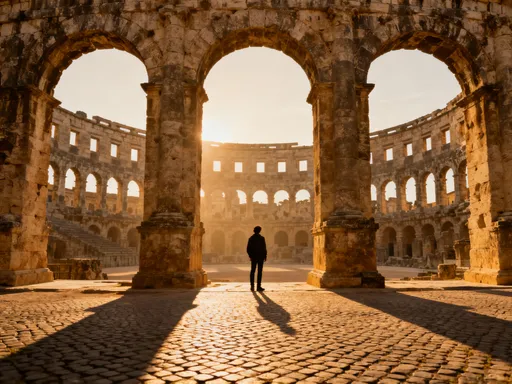
Rising from the city like a fortress of memory, the Pula Arena dominates the skyline with its imposing limestone walls and perfectly preserved arcades. Built in the 1st century AD during the reign of Emperor Vespasian, this Roman amphitheater was designed to seat approximately 23,000 spectators—nearly the entire population of ancient Pula. Unlike many ancient ruins that stand in silent solitude, the Arena is alive with purpose. It is one of the only six remaining Roman amphitheaters in the world with four side towers fully intact, a rare architectural survival that speaks to both Roman engineering and local preservation efforts.
The original function of the Arena was spectacle: gladiator battles, animal hunts, and public executions. Yet today, it hosts a different kind of performance—one rooted in culture rather than conquest. Each summer, the Pula Film Festival transforms the stone tiers into an open-air cinema, where visitors watch classic and contemporary films beneath a canopy of stars. The acoustics, remarkably preserved after two millennia, carry music and dialogue with clarity, making every note feel intimate despite the vast space. Concerts by international artists, historical reenactments, and even theatrical productions breathe new life into the ancient structure, creating a dialogue between past and present.
Walking through the underground passages, once used to house animals and gladiators, one can almost hear the echoes of anticipation that must have filled these dim corridors. The sheer scale of the construction—using local limestone and precise Roman masonry techniques—demonstrates a mastery of design that still impresses modern engineers. Its coastal location was strategic, allowing for easy transport of materials and visibility from the sea, reinforcing Pula’s status as a key Roman port. Today, the Arena is not a relic frozen in time, but a dynamic venue where history is not just remembered, but reimagined.
For visitors, especially those traveling with older children or teens, the Arena offers more than photo opportunities. Guided tours explain the social and political role of such spectacles in Roman society, helping families understand how entertainment was used to reinforce power. Audio guides are available in multiple languages, including English, making the experience accessible without sacrificing depth. The best time to visit is early morning or late afternoon, when the sun casts long shadows across the stone, enhancing the sense of grandeur. Whether attending a film under the stars or simply standing in the center of the arena, you feel a profound connection to the countless generations who have stood in the same place.
Temple of Augustus: A Glimpse into Imperial Worship
Just a short walk from the Arena, nestled in a quiet square, stands the Temple of Augustus—a serene and beautifully preserved monument from the 1st century BCE. Dedicated to the first Roman emperor, this small but elegant temple is a rare example of Roman religious architecture that has survived largely intact. Its six Corinthian columns, crowned with intricate acanthus leaf carvings, support a pediment that once held a statue of Augustus himself. The temple’s original dedicatory inscription, still visible on the base, reads: “To the Emperor Caesar Augustus, son of the divine, the Senate and people of Pula.” This simple phrase speaks volumes about the city’s integration into the Roman Empire and its reverence for imperial authority.
Unlike grander temples in Rome or Athens, the Temple of Augustus exudes intimacy. Standing before it, you don’t feel overwhelmed by scale, but drawn in by detail. The precision of the stonework, the symmetry of the design, and the quiet dignity of the space create a sense of reverence that transcends time. Originally part of a larger forum complex, the temple served as a center of civic and religious life, where officials gathered, oaths were sworn, and offerings made to the deified emperor. It was both a political statement and a spiritual sanctuary, reflecting the Roman belief in the divine right of rulers.
Today, the temple functions as a small museum exhibit, housing a collection of Roman statues, including a well-preserved figure of Roma, the personification of the city of Rome. The interior is modest but carefully curated, with informative panels explaining the religious practices of the time. Lighting is soft, allowing visitors to appreciate the texture of the stone and the subtlety of the carvings. There are no crowds here—just the occasional passerby pausing to admire the craftsmanship. For women who appreciate quiet reflection, this is a perfect spot to sit on a nearby bench, journal in hand, and contemplate the passage of time.
The temple’s survival is a testament to both its sturdy construction and the care of local custodians. Unlike many ancient sites that were dismantled for building materials, this temple was incorporated into later structures, protecting it from destruction. In the Middle Ages, it was used as part of a church complex, which helped preserve its form. Now, restored to its classical appearance, it stands as a bridge between Pula’s Roman past and its modern identity. Visiting it feels like uncovering a secret—something precious and personal, not just another item on a tourist checklist.
Local Museums: Where Stories Come Alive
Pula’s cultural richness extends far beyond its outdoor monuments. Inside its network of museums, the city’s story unfolds in vivid detail. The Museum of History, housed in a former Austro-Hungarian fortress, offers a chronological journey from prehistoric settlements to the 20th century. Its collection includes Illyrian pottery, Roman mosaics, medieval coins, and Venetian navigational instruments. What sets this museum apart is its narrative approach—each exhibit is designed to tell a story, not just display artifacts. One section recreates a Roman merchant’s home, complete with olive oil jars and woven textiles, helping visitors imagine daily life two thousand years ago.
Equally compelling is the City Gallery of Contemporary Art, located in a restored 18th-century palace. Here, the past and present converge in unexpected ways. Exhibits often draw inspiration from Pula’s maritime heritage, with artists using salvaged wood, fishing nets, and sea glass to create installations that reflect on identity and change. Temporary exhibitions feature regional and international artists, offering fresh perspectives while remaining rooted in local context. The gallery is especially welcoming to families, with interactive elements that engage children without distracting from the art.
Both museums prioritize accessibility. Admission fees are modest, and guided tours are available in English and Italian. Audio guides and printed brochures provide additional context, making self-guided visits equally rewarding. The staff are knowledgeable and approachable, often sharing personal anecdotes about the collections. For women who enjoy learning at their own pace, these museums offer a comfortable environment—well-lit, climate-controlled, and free of the crowds that plague larger institutions. Benches are placed throughout, encouraging rest and reflection.
One of the most touching exhibits is dedicated to Pula’s maritime trade history. Through maps, ship models, and personal letters, it traces the journeys of local sailors who crossed the Adriatic, connecting Pula to Venice, Ancona, and beyond. Their stories—of adventure, loss, and return—resonate deeply, especially for those who have waited for loved ones at home. The museum doesn’t glorify the past but presents it with honesty, acknowledging both prosperity and hardship. This balanced portrayal makes the history feel real, not romanticized. It’s a reminder that culture is shaped not just by emperors and architects, but by ordinary people whose lives echo through time.
Off-the-Beaten-Path Cultural Spots
While the Arena and the Temple of Augustus draw the most attention, Pula’s soul lies in its quieter corners. A short walk from the city center, within a leafy park, is a small lapidarium—a collection of ancient stone fragments, inscriptions, and architectural remnants. Unlike formal museums, this open-air display feels personal, as if someone carefully gathered family heirlooms and laid them out for all to see. The stones are labeled with simple plaques, explaining their origins and significance. Some bear Latin inscriptions honoring long-forgotten citizens; others show the wear of centuries, their edges softened by wind and rain.
Another hidden gem is a community-run ethnographic exhibit housed in a former schoolhouse. Managed by local volunteers, it showcases traditional costumes, handwoven textiles, and household tools from the 19th and early 20th centuries. The displays are modest but heartfelt, arranged with care and accompanied by handwritten notes in Croatian and English. One section features a recreated kitchen, complete with a wood-fired stove and ceramic dishes, offering a glimpse into the lives of Pula’s grandmothers. The warmth of the space comes not from its artifacts alone, but from the obvious pride of those who maintain it.
Throughout the summer, pop-up art exhibitions appear in unexpected places—abandoned warehouses, seaside pavilions, even old tram stations. These temporary installations are often the work of young Croatian artists experimenting with identity, memory, and place. They’re free to enter and rarely advertised, discovered instead by word of mouth or chance. Visiting one feels like being let in on a secret, a moment of connection between traveler and community. For women who value authenticity over spectacle, these spaces offer some of the most meaningful experiences in Pula.
Finding these spots requires a bit of curiosity and local interaction. Asking a shopkeeper or café owner for recommendations often leads to the best discoveries. Many residents are happy to point out lesser-known sites, especially when they sense genuine interest. These off-the-beaten-path locations aren’t designed for mass tourism—they’re maintained out of love, not profit. That makes them fragile, but also precious. Respecting the space—keeping voices low, not touching fragile items, leaving no trace—is part of the experience. In these quiet places, you don’t just see culture; you participate in its preservation.
Cultural Events That Define the City’s Rhythm
Pula’s cultural calendar is shaped by events that transform history into living performance. The most famous is the Pula Film Festival, held annually in July and August within the Roman Arena. Established in 1953, it is one of the oldest film festivals in Europe. Each night, the ancient stone walls become a screen for cinematic art, with classics and contemporary films projected under the stars. Tickets are affordable, and seating is general admission, creating a relaxed, communal atmosphere. Families bring blankets, couples share wine, and solo travelers find seats among friendly strangers. The combination of film, history, and night sky creates a magic that no modern theater can replicate.
Another highlight is the summer solstice celebration, when local groups gather at ancient sites like the Temple of Augustus to honor the longest day of the year. Though not a reconstructed pagan ritual, the event includes music, poetry readings, and candlelight processions that evoke a sense of continuity with the past. It’s informal and inclusive, drawing both residents and visitors. The city also hosts traditional craft fairs in June and September, where artisans sell handmade jewelry, ceramics, and textiles. These events are held in the old town squares, often accompanied by live folk music and local food stalls.
For families, the Children’s Cultural Week in May offers workshops in storytelling, puppetry, and traditional dance. Held in community centers and open parks, these activities are free and led by local educators. They provide a wonderful opportunity for children to engage with Croatian culture in a playful, hands-on way. Meanwhile, classical music concerts take place in historic venues throughout the summer, from chamber ensembles in the City Gallery to full orchestras in the Arena. The acoustics of these ancient spaces enhance the music, making each note resonate with depth and clarity.
What unites these events is their integration with the city’s physical and cultural landscape. They don’t feel imported or commercialized, but rooted in place. Attending them allows visitors to experience Pula not as spectators, but as participants. Tickets for most events can be purchased online or at local tourist offices, and schedules are posted in English. Crowd levels vary—film festival nights can be busy, but weekday concerts and craft fairs remain intimate. The best strategy is to arrive early, find a comfortable spot, and let the atmosphere unfold naturally. These moments—listening to music in a 2,000-year-old arena, watching children dance in a medieval square—are the ones that stay with you long after you’ve returned home.
How to Experience Pula’s Culture Like a Local
To truly connect with Pula, it helps to shift from sightseeing to savoring. Locals don’t rush from monument to museum; they weave culture into daily life. A morning walk might include a stop at a family-run bar for a strong espresso and a slice of štrudla, a traditional pastry filled with apple or cheese. Conversations with shopkeepers, even brief ones, often lead to unexpected invitations or recommendations. A simple “Dobar dan” (good day) goes a long way in building rapport.
Timing is key. Visiting major sites early in the morning or late in the afternoon avoids both crowds and midday heat. The light is softer, the air cooler, and the spaces feel more personal. Combining visits with coffee breaks or leisurely lunches allows for reflection and rest. Many cultural spots are within walking distance of each other, making it easy to create a self-guided tour at your own pace. Wearing comfortable shoes is essential—the streets are paved with smooth stone, but uneven in places.
Talking to local guides, especially those affiliated with official tourist services, adds depth to the experience. Many are historians or artists who speak fluent English and offer insights you won’t find in guidebooks. Private tours can be arranged in advance, but even a 30-minute guided walk provides valuable context. Respecting preserved spaces—by not touching ancient stones, keeping voices low in quiet areas, and following posted rules—ensures these sites remain accessible for future generations.
For women traveling alone or with family, Pula is both safe and welcoming. The city has a low crime rate, and locals are accustomed to tourists. Public transportation is reliable, and signage is clear in both Croatian and English. Most importantly, there’s no pressure to see everything. Some of the most memorable moments happen when you linger—a woman painting by the harbor, an old man playing chess in the square, the sound of waves against the seawall. These quiet interactions, more than any checklist, define the essence of Pula.
Why Pula’s Past Is Its Greatest Gift
Pula’s cultural sites are not relics frozen in time, but living threads in a continuing story. The Arena, the Temple, the museums, and the hidden courtyards are not just places to visit—they are invitations to participate. By exploring them with curiosity and respect, travelers do more than observe history; they become part of its ongoing narrative. The city teaches a quiet lesson: that heritage is not something to be consumed, but to be carried forward with care.
For women who seek travel that nourishes the spirit, Pula offers a rare depth. It doesn’t dazzle with excess, but reveals itself gradually, like a letter written in invisible ink that only appears with patience and attention. The journey through its streets is not about collecting photos, but about collecting moments—of awe, of connection, of stillness. In a world that often feels rushed and fragmented, Pula reminds us that some things endure: beauty, craftsmanship, community.
The greatest gift of Pula is not its monuments, but the way they make you feel—connected across time, grounded in place, and deeply human. It’s a reminder that the most meaningful journeys are not measured in miles, but in moments of quiet recognition. When you stand in the center of the Arena and look up at the sky, or trace your fingers over a Roman inscription, you’re not just seeing the past. You’re feeling it. And in that feeling, you find not escape, but belonging.